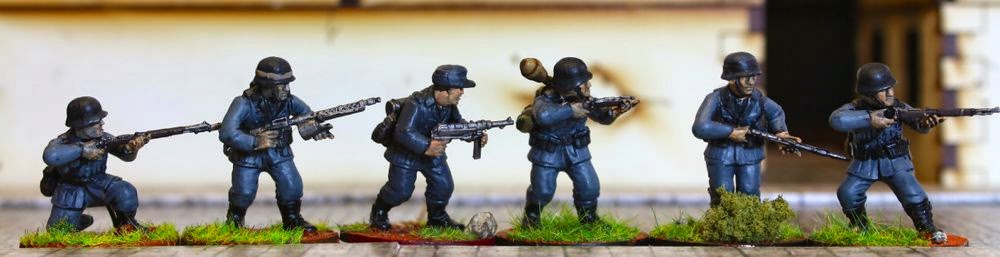
Plastics or Metal? Which is better for your model soldiers?
My position is that both have their advantages and disadvantages. Metals need to be cleaned up by removing flash and perhaps straightening guns and adding a larger base, the proper undercoat is important, and there are many. but limited, poses for the men.
Also, the paint tends to chip on metals during use.
Meanwhile, plastics are cheaper, but they need to be assembled which can be fiddly, the guns can break and they don't have the same weight and heft as metal figures.
However, there is one argument I was challenged with that there are limited poses in the plastics because there are only 5 body shapes and limited arm options. To answer that challenge I present photos of 94 models made from the standard Warlords German Infantry plastic figures.
Have a look and see how many are the same. There may be a few similar, but I contend none are the same. This isn't bad as these are created all from the same sprue containing enough bits for 5 men.
Some figures we modified the legs or arms with a bit of green stuff or selective cutting or trimming with a knife, but the majority (over 90%) are just made with the standard sprue and imagination.
A blog dedicated to wargaming - especially Bolt Action WWII games. We aim to play the whole game - figures, scenery, terrain and the story - for players and spectators in demonstration and public participation games.
Thursday, 20 March 2014
Monday, 17 March 2014
Sarissa Precision WWII collection
![]() |
| A Little Sarissa Precision village |
We had previous experience with their Pegasus Bridge set which has proven to be a great kit, so I thought it was time to review their other buildings.
The kits use 2mm MDF for the main construction and 1mm cardboard for various highlights and features such as window and door trims, shutters, etc.
To get depth, the kit uses multiple pieces glued together.
![]() |
| Just add water |
Construction is pretty straight forward and the pieces all come out of the sheets well.
The instructions are pretty basic. For Pegasus Bridge, the model was complex and naturally the instructions needed a little deciphering.
Pre-planning by dry fitting everything together and then applying glue worked well. We just used PVA glue to join the pieces. This allowed a bit of give while it was drying.
The MDF seems to absorb some of the PVA's moisture, so the fit is reasonably firm.
The models are much simpler than 4Ground's kits.
There are no internal walls or stairs, but you can remove floors and walls.
![]() |
| Lots of room inside - but no walls or stairs. |
![]() |
| We don't even play wargames! |
So, being simpler kits and unpainted, the benefit is price. The terrace or small house is about $20 Australian. The 4Ground Terrace house is around $42.
As always, you trade cost vs convenience.
But we like having some variety and are very grateful to have such a wide choice of buildings designed for wargaming. And by making us paint the buildings, we will certainly have personalised scenery.
Saturday, 15 March 2014
Bolt Action - A Game To Play
The biggest challenge of any set of wargaming rules is determining the balance between historical accuracy and gameplay.
And there must be sacrifices for gameplay.
For example, consider ground scale. When using 28mm figures, a consistent ground scale should be around 1km = 14 metres. While accurate, this would prove to be very difficult to recreate on a table top!
Add in time scales, movement speeds and before we even come to weapons, armour and battle damage and effects, we have made a ton of compromises.
Now, that is a good thing. Some rules focus more on infantry, or armour, or larger or smaller scale battles. This variety is what makes the hobby so interesting.
So with that background in mind, why has Bolt Action set the WWII historical wargaming scene on fire? It isn’t just because Warlord Games published their own rule set and del their own collection of models and figures. Other game companies do this all the time. It is a time honoured tradition and helps companies sell their figures. We still enjoy the occasional Pirate game using really simple rules published by an Australian miniatures company.
So what makes Bolt Action different?
![]() |
| It's all in the bag! |
1. The Order Dice Game Mechanic
This is radical.By default, most wargame rules have used the “I go You go” method of playing. This means your plans can more or less be followed faithfully by the troops.
In Bolt Action a “turn” is actually a series of mini turns for when each order die is pulled from the bag. The game can - and often does - change fundamentally in several directions in the course of one turn depending not only who gets the die, but which unit he activates and how well that unit does. In Bolt Action, the tension is high because you need the die before he does or your unit may not survive! Or you want the last die because then your opponent will have to take his lumps.
![]() |
| A Russian Officer instructing his troops |
2. The generalizing of units.
The armour ratings, morale and guns are all grouped into classes. So even though there are historical differences in armour of a centimetre here or there, from a game play point of view it isn’t that important.This suddenly takes away a lot of the complex maths which didn’t add significantly to the game anyway. In the rules I wrote so long ago we had a very exhaustive list of weapons and tanks with armour ratings for each side and different speeds and damage and hit ratings depending on distances. Those 20 pages or so of really good statistics are summarized in half a page in Bolt Action. And the game is not impacted negatively. Which leads to point 3.
![]() |
| And he played the whole day! |
3. The streamlining of the game mechanics.
Having a simplified and standardised set of hit chances and modifiers means it takes very little time to memorise the main rules.Normally, it takes some time to teach a new player how the game works. With Bolt Action, we have found brand new players understand the game and make valid game choices half way through turn one!
This is how you can quickly gain wargaming converts. If an interested bystander can join in a game and get actively involved quickly, they tend to keep playing. We have seen many demonstration games where new players are reduced to lackeys that move figures and roll dice as the rules are a dazzling array of charts and numbers and options. Their interest wanes as the other side takes their gigantic move and their attention wanders.
![]() |
| A sure fire plan doesn't survive contact with the enemy. |
4. There is the chance for things to go wrong – really wrong.
FUBAR (Fouled Up Beyond All Recognition) is not just an effect of a 12 when rolling morale. It can be said to apply when you roll a 1 for artillery or air strikes (and hit your own troops), or run out of fuel for your mega powerful flamethrower, or fail to come on the board for that planned devastating flanking move.On the other hand, things can also go really right. Even when the odds of hitting are pretty remote, a 6 and a 6 can still be tried. All this combines to make the game a great challenge, but also fun.
There are times when the dice gods conspire and nothing goes your way. That can happen with all rules. But somehow, with so many things happening in a 6 (or 7) turn game, odds are you will offset the terrible rolls with some great rolls and it all balances out.
![]() |
| A Commando Comic Moment |
5. Finally, it’s cinematic
A wargame is not a historical re-enactment. Much as we would like to kid ourselves that it is, the majority of historical battles were won and lost based on overwhelming odds and logistics of getting to the right place with more or better stuff than the other guy.Bolt Action is still historic and bound by the historical facts and figures. That is great because you will not be suddenly confronted with a brand new figure by the games company which wrecks the game play. A WWII British rifleman will still be able to be used as such for years to come.
But a wargame has to be balanced or it isn’t much of a game.
Bolt Action balances the historical aspect with easy to learn gameplay leading to lots of valid choices. The main effect is that playing a game of Bolt Action is like being in a movie or war comic. And the after game discussions are filled with what happened as well as lots of alternative happenings too – if only the dice went this way instead.
So why play Bolt Action? Because it’s fun.
(This article was also published on BoltAction.net. This is a great source of Bolt Action articles and discussions about Bolt Action and WWII wargaming in general.)
Tuesday, 11 March 2014
Great Modelling how to articles
The Architects of War have an excellent page detailing a number of modelling tips and techniques.
I especially found the following VERY useful:
About Big Trees - This helped me a lot in understanding trees and modelling scales.
Making Roads - an easy way to build roads using shingles. More non Australian centric as it is not so easy to get shingles here, but the concept is certainly helpful.
Enjoy.
I especially found the following VERY useful:
About Big Trees - This helped me a lot in understanding trees and modelling scales.
Making Roads - an easy way to build roads using shingles. More non Australian centric as it is not so easy to get shingles here, but the concept is certainly helpful.
Enjoy.
Saturday, 8 March 2014
City Fight - How would you fight this board?
We are planning our next demo game to be an all day long affair with multiple players on one board.
The board is a standard 6 x 4 but as you can see, it is a full on city fight. We want everyone to have a great day playing - for as long as they are able to participate. We know that buildings are meat grinders and there will be high attrition. That is why objectives are central and why restarting with new armies or reinforcements is important.
The concept:
Each player has 750 points.
At least 2 players a side, but this will change as the day progresses.
There will be certain objectives set up - such as hold certain buildings for 2 turns, get to the other sides command point, and so on. Each objective gained earns 1 Victory point for that team (and the player) Also a VP for certain points destroyed.
As the day progresses, other players can come in on either side, and players whose armies are destroyed can start again.
Dice are pulled for each 2 player pairing and I don't care if one pairing goes faster than another. New players join the pair of players with the least dice left.
These are my starting thoughts. I would really appreciate your input.
We will be play testing this soon with some extra players, but the board looks pretty enticing.
The board is a standard 6 x 4 but as you can see, it is a full on city fight. We want everyone to have a great day playing - for as long as they are able to participate. We know that buildings are meat grinders and there will be high attrition. That is why objectives are central and why restarting with new armies or reinforcements is important.
The concept:
Each player has 750 points.
At least 2 players a side, but this will change as the day progresses.
There will be certain objectives set up - such as hold certain buildings for 2 turns, get to the other sides command point, and so on. Each objective gained earns 1 Victory point for that team (and the player) Also a VP for certain points destroyed.
As the day progresses, other players can come in on either side, and players whose armies are destroyed can start again.
Dice are pulled for each 2 player pairing and I don't care if one pairing goes faster than another. New players join the pair of players with the least dice left.
These are my starting thoughts. I would really appreciate your input.
We will be play testing this soon with some extra players, but the board looks pretty enticing.
Wednesday, 5 March 2014
The Sicilian CBD
![]() |
| Is it dinner time yet? |
As we did with the Beer Factory we have renamed ours to something more memorable - The Sicilian CBD. We ordered the Restaurant (Model 28B3) and the Hotel (known as Model 28A3) and a collection of the stone walls (Model 28S3). One thing about Crescent Root Studio - they really know how to give their great buildings catchy names.
Each building is pre-painted and mostly assembled. All you have to do is attach each wall using small metal pins and you are ready to go.
![]() |
| The Hotel and Restaurant |
![]() |
| Plenty of place for your guys. |
![]() |
| Worth fighting for |
![]() |
| The side buildings are optional. |
![]() |
| We want the hotel! |
Saturday, 1 March 2014
The Easy Path to Cobblestone Roads
![]() |
| It all starts with 3mm MDF |
We discovered Dave Graffam Models' selection of paper scenery, available from The Wargame Vault. At $2.95 (USD) this is a very good price for the designs. The kit is in the form of a PDF and uses Layers to have varying road and sidewalks (footpaths). Mac users will need to download Adobe PDF Reader to see and select the various layers.
At Cancon we saw one of the players had used the method we explained and did it even better. So learning from experience, here is a more detailed guide on how to make easy cobblestone roads.
It all starts with a sheet of 3mm MDF. We cut this into 15cm (6 inch) squares.
![]() |
| Some glue and the printed out roads. |
Using Adobe PDF reader, view Layers and you will be able to choose from a variety of road and pavement/side walk options. You can also print sheets of the same type which can be used for a plaza or to cut smaller for lanes and alleys.
If you print out the PDF section without any resizing, it will be slightly larger than 15cm/6" which is fine.
We will be making the sheet slightly 3D by making the sidewalks separately and gluing them to the base later.
For glue we used Spray Adhesive which made the job a bit easier. When we ran out, we used PVA glue and a paintbrush to do the same job.
In the picture here we have a straight road section, a street cross roads and a full pavement section for use as a plaza, and to create the side walks.
![]() |
| Apply glue to the back of the section |
![]() |
| Place the MDF square in the centre |
![]() |
| Trim the excess |
![]() |
| Cut a strip to use for pavements |
![]() |
| Now cut them long enough for the MDF squares |
![]() |
| Glue the pavement to the strip |
![]() |
| Glue the pavement to the square |
![]() |
| Once dry apply clear varnish |
![]() |
| An afternoon's work |
![]() |
| Look both ways before you cross |
![]() |
| Use them as a base for other scenery too. |
Subscribe to:
Posts (Atom)
LinkedWithin
You may also find these posts of interest: